

8th ICRS Summit — Joint Preservation: The Regenerative Era is Underway
Relationship Between Radiographic Knee Osteoarthritis Severity and Hip Movement Quality in Patients Without Hip Osteoarthritis
C.R.A.F.T. Scores Across Kellgren–Lawrence Grades in 177 Patients
Hip movement quality deteriorated as radiographic knee osteoarthritis worsened — in patients who had no hip osteoarthritis at all. Three of five C.R.A.F.T. hip scores differed significantly across Kellgren–Lawrence grades.
Where and when
- Accepted
8th ICRS Summit — Joint Preservation: The Regenerative Era is Underway
International Cartilage Regeneration & Joint Preservation Society
October 2026Porto, Portugal
This study was also accepted at BOA 2026.
Authors
- Feza Korkusuz — First author, Hacettepe University, Ankara
- Paul Lee — Co-author, MSK Doctors, Sleaford
- Tanvi Verma — Co-author, MSK Doctors, Sleaford
- Selin Demirel — Co-author, Hacettepe University, Ankara
Themes
Scientific Focus
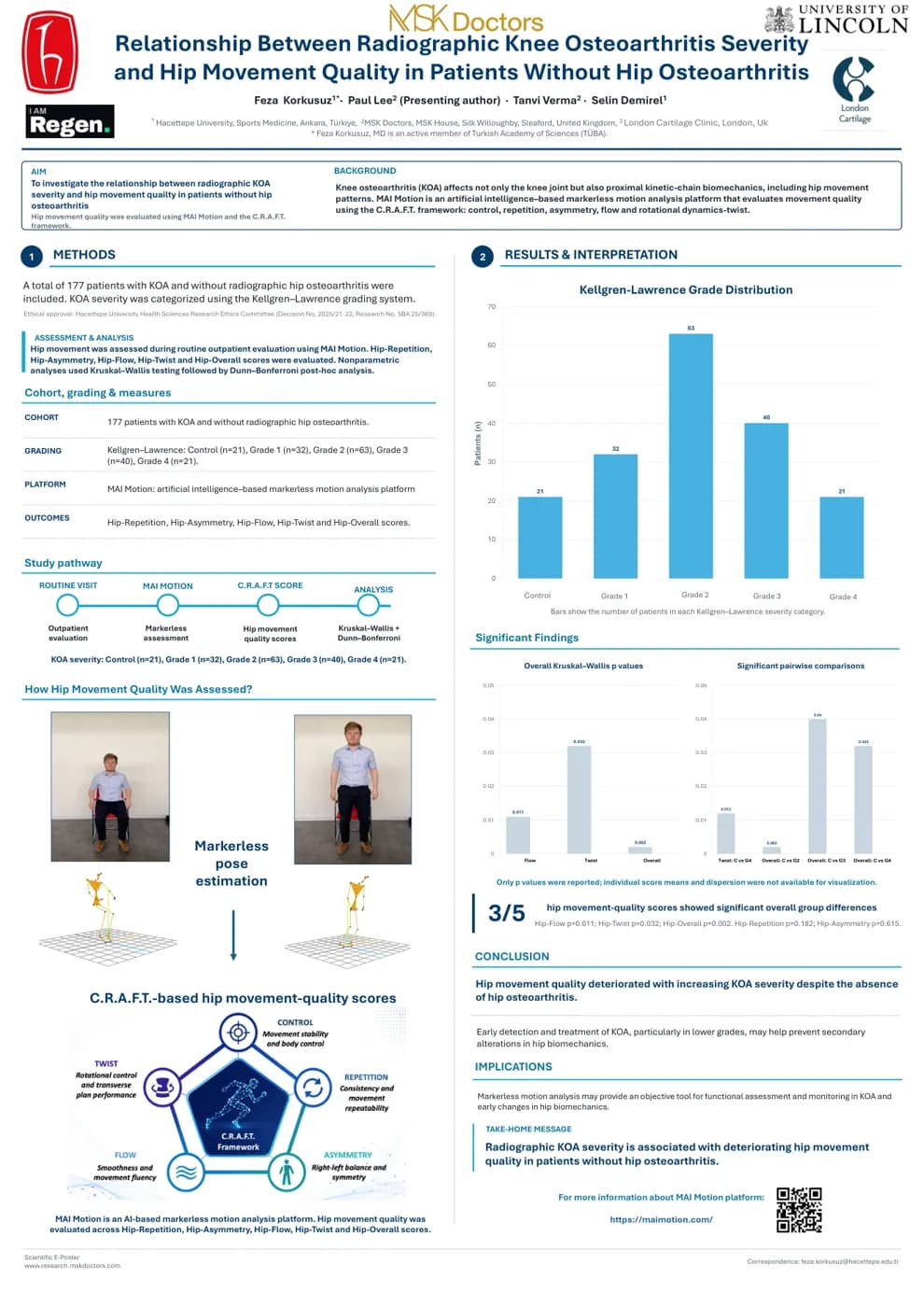
Knee osteoarthritis affects not only the knee but proximal kinetic-chain biomechanics, including hip movement patterns. This study assessed 177 patients with knee osteoarthritis and no radiographic hip osteoarthritis, graded by Kellgren–Lawrence — control (n=21), grade 1 (n=32), grade 2 (n=63), grade 3 (n=40) and grade 4 (n=21). Hip movement was captured during routine outpatient evaluation using MAI Motion, an AI-based markerless platform, and scored on the C.R.A.F.T. framework: control, repetition, asymmetry, flow and rotational dynamics (twist). Analysis used Kruskal–Wallis testing with Dunn–Bonferroni post-hoc comparison. Ethical approval: Hacettepe University Health Sciences Research Ethics Committee, Decision No. 2025/21-22, Research No. SBA 25/369.

Why It Matters
Three of the five hip scores showed significant overall group differences — Hip-Flow (p=0.011), Hip-Twist (p=0.032) and Hip-Overall (p=0.002) — while Hip-Repetition (p=0.182) and Hip-Asymmetry (p=0.615) did not. Significant pairwise comparisons were Twist control versus grade 4 (p=0.012), and Overall control versus grades 2, 3 and 4 (p=0.002, 0.04 and 0.032). The finding is that the hip is already moving differently before it shows any radiographic disease of its own, which suggests early detection and treatment of knee osteoarthritis — particularly at lower grades — may help prevent secondary changes in hip biomechanics. Only p values were reported; individual score means and dispersion were not available.
 View full size
Next in the programme
Evaluating the Effect of Electrical Muscle Stimulation (EMS) on Post-Operative Musculoskeletal Function and Recovery
BOA Annual Congress 2026 · September 2026