

8th ICRS Summit — Joint Preservation: The Regenerative Era is Underway
ChondroFiller as a Single-Stage Treatment for Knee Cartilage Defects: Early Clinical Outcomes
Early Clinical Outcomes of a Single-Stage Collagen Gel
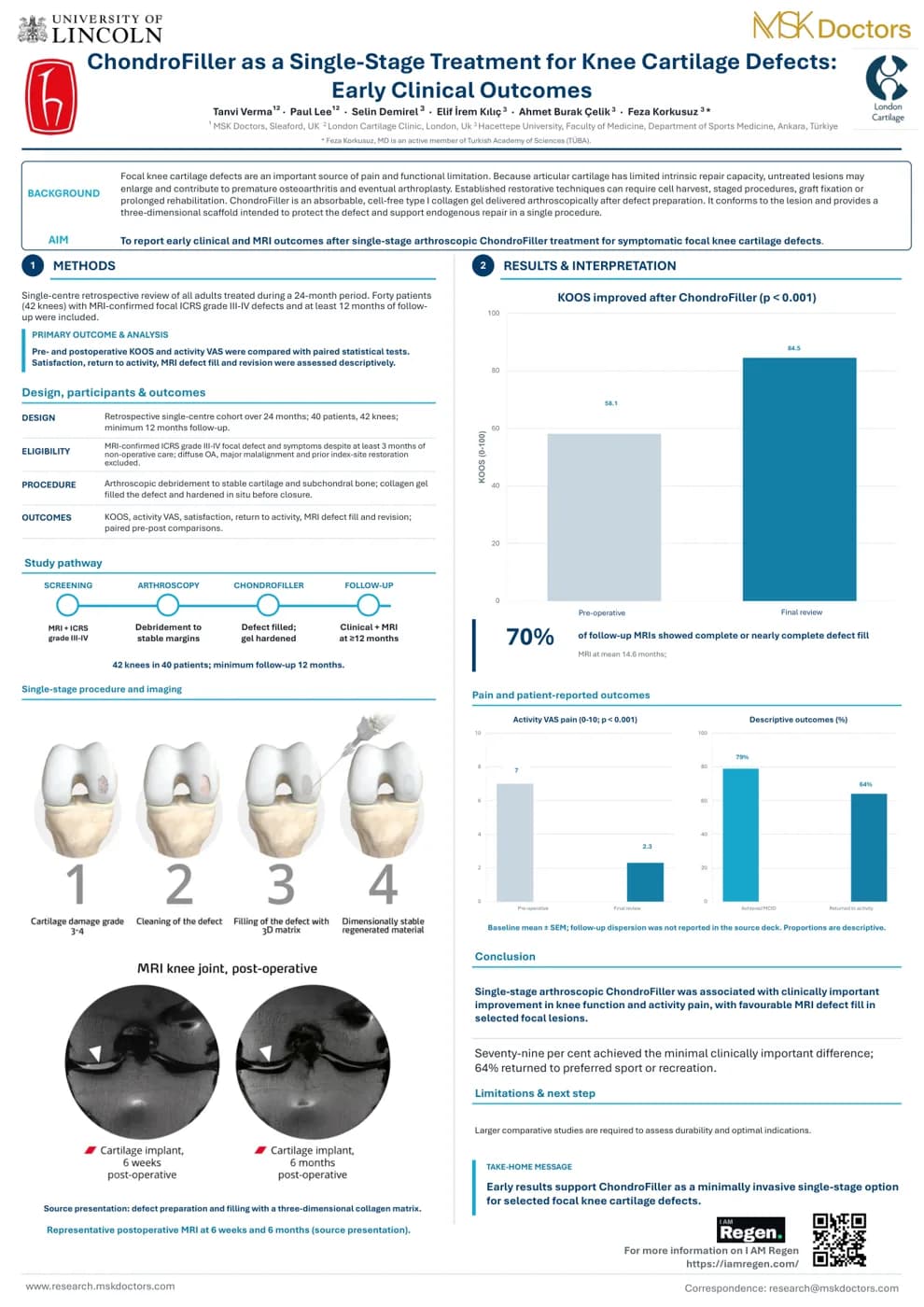
A retrospective review of 42 knees treated arthroscopically with a cell-free collagen gel in one sitting. KOOS rose from 58.1 to 84.5 and activity pain fell from 7 to 2.3, with 79% reaching the minimal clinically important difference.
Where and when
- Accepted
8th ICRS Summit — Joint Preservation: The Regenerative Era is Underway
International Cartilage Regeneration & Joint Preservation Society
October 2026Porto, Portugal
This study was also accepted at BOA 2026.
Authors
- Tanvi Verma — First author, MSK Doctors, Sleaford; London Cartilage Clinic
- Paul Lee — Co-author, MSK Doctors, Sleaford; London Cartilage Clinic
- Selin Demirel — Co-author, Hacettepe University, Ankara
- Elif İrem Kılıç — Co-author, Hacettepe University, Ankara
- Ahmet Burak Çelik — Co-author, Hacettepe University, Ankara
- Feza Korkusuz — Co-author, Hacettepe University, Ankara
Themes
Scientific Focus
Articular cartilage has limited intrinsic repair capacity, so untreated focal defects may enlarge and contribute to premature osteoarthritis and eventual arthroplasty. Established restorative techniques can require cell harvest, staged procedures, graft fixation or prolonged rehabilitation. ChondroFiller is an absorbable, cell-free type I collagen gel delivered arthroscopically after defect preparation: it conforms to the lesion and hardens in situ, providing a three-dimensional scaffold intended to support endogenous repair in a single procedure. This single-centre retrospective review covered 40 patients (42 knees) with MRI-confirmed ICRS grade III–IV defects and at least 12 months of follow-up, excluding diffuse osteoarthritis, major malalignment and prior restoration at the index site.
Why It Matters
KOOS improved from 58.1 to 84.5 and activity VAS pain fell from 7 to 2.3, both at p < 0.001. Seventy-nine per cent achieved the minimal clinically important difference and 64% returned to their preferred sport or recreation. Follow-up MRI at a mean of 14.6 months showed complete or nearly complete defect fill in 70% of cases. The proportions are descriptive rather than inferential, and follow-up dispersion was not reported in the source deck — the authors state that larger comparative studies are required to assess durability and optimal indications.
 View full size
Next in the programme
Clinical Outcomes Following ChondroFiller Injection Treatment for Ankle Cartilage Defects
8th ICRS Summit — Joint Preservation: The Regenerative Era is Underway · October 2026